In my mind, it is ultimately very important to have favourites in perfumery because it puts principle into practice. The more I delve into my personal tastes as both a reviewer and a consumer, the increasingly static my tastes become. The wardrobe feature on Fragrantica forces some sort of contemplation, for the simple reason that you’re limited to 5 favourite perfumes and 1 signature perfume. If finding 5 favourites wasn’t hard enough, having to pinpoint 1 signature fragrance is indeed a challenge.
As I began collecting fragrances, inevitably the wardrobe grew. And as a fragrant spelunker, favourites would come and go, and change with an intense rapidity of pace. Brin de Reglisse took the signature spot for a long period of time, and now it no longer exists on the covetable 5. Simple reason: tastes morph. Yet as long as I do not forget the impact Brin de Reglisse had, then there is no shame in moving it away from its place on a pedestal. Without discovering Brin, I may not have discovered everything else. In that way, it is important not to dwell, but to accept this infinite exchange for it makes me a better explorer of scent. I do not love Brin any less either. Smell everything but do not buy just anything.
Then came Portrait of a Lady, a worthwhile contender and indeed it took Brin’s place for a heavy chunk of a year. The question pertinent to this post, why? Portrait of a Lady had the same effect of intense excitement: a structure to be explored with deliciously intriguing facets. And now, while POAL no longer sits on the Fragrantica shelf, it still exists as a firm favourite. It had its time and I explored it well. The mystery remains, perhaps more familiar now, and is concurrently understood with an intimate closeness.

Photo by Fragrantica
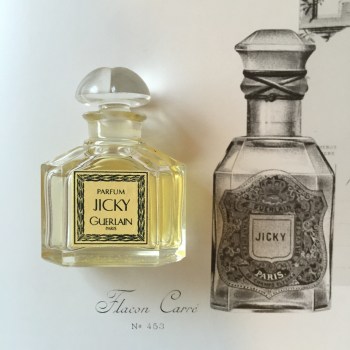
Jicky is a wonderful signature, and is still my signature (at the time of writing), despite disappearing for 2 months in favour of the original Comme des Garcons EdP. I chuckle thinking about it, especially in conversation when I explain this process, but it makes perfect sense to me. CdG is objectively a good fragrance, insofar that I’ll contend that it’s a great fragrance. When I first approached it, it had a structure of wonderful mysteriousness, at once approachable yet foreign; like seeing someone in the distance, unsure if it’s a friend or a stranger. As these 2 months progressed, the structure became less and less mysterious as I wore the fragrance and it became known to me. The hovering transparency which made CdG novel was used as a comparative standard against other scents. Ultimately, intimacy diminished its signature status.
But Jicky is back on and alloyed to the pedestal. Jicky is unmistakably glorious (as are most of the Guerlain’s, up until the late Jean-Paul Guerlain period) in its contradiction focuses on simple complexity, and that produces a heap of intrigue when wearing. Jicky is not a grand perfume. It is a naturalistic countryside, clashed with the abstract swirl of synthetics. It has been my signature for around a year now, and I don’t think it’s going anywhere anytime soon … not until I get swept away by another Guerlain, Chanel or Lutens.
 © 2015 Liam Sardea
That’s the thing with those old school Guerlain or Chanel fragrances or even certain Lutens perfumes, they do not so easily reveal the entirety of their structure and their composition as a whole, and thus they are for a long time mysterious and exciting to wear on that level. Brin de Reglisse eventually revealed itself in what I think is its entirety, as did POAL. Minimalistic structures (in that bare-boned style) do not make good signatures for that reason, nor do Frederic Malle fragrances because they are totally legible after a few good wears. L’Heure Bleure will continue to reveal facets of itself for many years of wear, as will Chanel’s Cuir de Russie, Patou’s Joy, Iris Silver Mist, Ambre Sultan, Bel a Versailles, and perhaps some of the more modern Chanel Les Exclusifs… To name a few. To explain this is beyond me right now, but I’ll try to tackle this problem for future discussion.
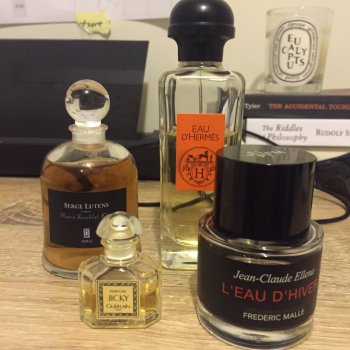
But this is a pedant’s view of what a signature scent should be, in which I am interpreting signature as my favourite scent, right now. What is worth the most time, what is the most mysterious, and what perfume comes back to me and asks me a question? Signature for any other person may mean what marks your identity, and what is yours. In which I respond Jicky… Initially, perhaps immediately at first, but then tremulously concede that Eau d’Hermes, Habit Rouge, L’Eau d’Hiver, La Myrrhe, No. 18, Cuir d’Ange, and Muscs Khoublai Khan all have some place in this consideration. Luckily, however, Fragrantica allows me to showcase a total of 6 scents. But alas, I have listed 8. This is the problem, and a consequently intellectual consideration: what is the point of demarcation between a good scent that is also a favourite, and plainly what I deem to be a good scent? What is want, and when does it become a need?
The question then moves into what do you wear when you’re not reviewing scent? I am not a zen-charged purist, and I indeed wear a wide array of scents and virtually never go scentless. One argument is to wear a perfume according to mood. True, but I don’t think an individual will wear a certain scent if they feel like eating coq au vin. Moods need to be placed into categories. Happy, sad; broad. Fragrance choices based on seasonality is wonderful too. The popular perspective, and perhaps the one I adhere to the most is a scent for every note, and going further into each style of a note. Rose can be moulded as a chypre, singular, symphonic, fizzy, bloody, spicy, …etcetera. Perfectly good excuses to wear multiple scents of the same focal note … But if you don’t like galbanum, then don’t buy it for the sake of owning a galbanum! Build towards it.
Reader: there has not been much time to think about scent, because I have university exams to tend to. But, I’ll be free soon, and devilishly fragrant…fragrant-er.


 Olfactics
Leave a comment